
Sanction busting keeps Russian missile production going - The Russia-Ukraine War Situation Report, day 1,433
Your daily digest for the Russia-Ukraine War.

RUSSIA-UKRAINE WAR SUMMARY DAY 1,433
The Big Story: Sanction busting keeps Russian missile production going
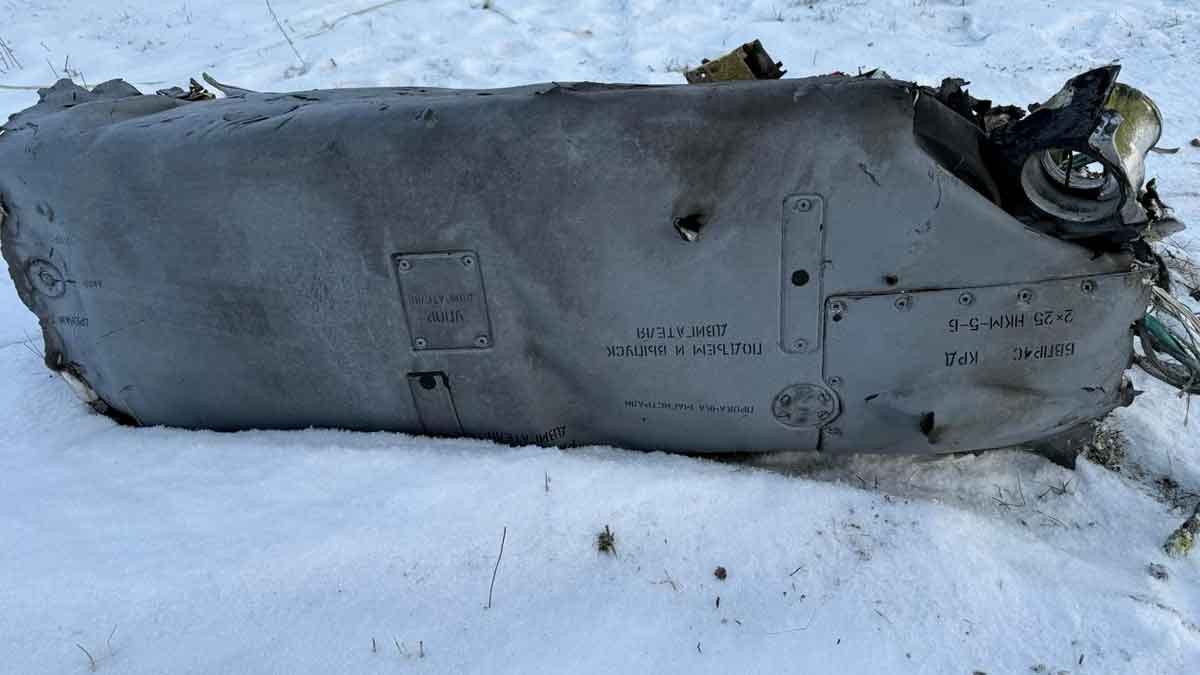
Ukraine’s envoy and advisor to the President on sanctions policy, Vladyslav Vlasyuk, pointed out that recovered debris of Russian missiles and Shahed strike drones reveal that they are being used as quickly as they come off the assembly line. Some of the missiles used to strike Kyiv and Kharkiv over the weekend were produced in 2026.
We’ve reported since 2024 that Russia has been forced to move to a “just in time” model, indicating that inventory levels are low and the supply chain is fragile. However, the fact that Russia can still produce 60 to 80 missiles a month shows that, despite sanctions, the supply of critical Western parts is still flowing.
A total blockade is impossible due to dual-use goods, but if a handful of key components were targeted, production of the Iskander-M and the Kh-47M2 Kinzhal could be significantly slowed.
Daily Assessment
We assess the following:
1. In our assessment, recent drone and missile debris collected in Ukraine, showing munitions used were produced in early 2026, indicates that the Russian supply chain for Western parts is fragile, while confirming the continued bypassing of sanctions due to lax enforcement.
2. Autocrat Vladimir Putin continues to negotiate in bad faith, remaining fully committed to his short-term, medium-term, and maximalist goals, while Moscow again rejected the current U.S.–Ukraine–European 20-point peace framework.
3. We maintain that the recent threats by the United States to seize Greenland by force and the minimizing of NATO’s contribution to the U.S. Global War on Terrorism (GWOT) have irreparably damaged the NATO Alliance and transatlantic relations. However, the impact on Ukraine and the potential for reduced support are unclear.
4. Barring a major unforeseen event or the use of chemical, biological, radiological, or nuclear weapons (CBRN), it is extremely unlikely that Russian forces will capture the remainder of the Donetsk oblast by the end of February 2026, as ordered by Putin.
5. The fastest path to end the Russia–Ukraine War and reach a just peace is through historically punitive sanctions and their strict enforcement.
The rest of our daily assessment is available in the downloadable Situation Report.
Today’s full Russia-Ukraine War SITREP No. 976, for 23-26 January 2026, is 41 pages long and is a full report. Here is today’s summary.
It has been 4,358 days since Russia started the Russia-Ukraine War by invading Crimea, and 1,433 days since Russia expanded its war of aggression against Ukraine.
You can visit our interactive Russia-Ukraine War Map for the latest tactical situation in the theatre of war.
Theaterwide
Kremlin spokesperson Dmitry Peskov described the weekend trilateral talks between the U.S., Ukraine, and Russia as “constructive,” with talks set to continue on February 1. Ukrainian President Volodymyr Zelenskyy noted that complex political issues remain unresolved and centered on territorial matters. Russia continues its demand for a full Ukrainian withdrawal from Luhansk and Donetsk, while claiming Zaporizhzhia and Kherson oblasts, including the Zaporizhzhia Nuclear Power Plant.
Russian head of the National Welfare Fund, Kirill Dmitriev, was replaced as lead negotiator by GRU head, General Igor Kostyukov, possibly due to Kyrylo Budanov’s new role.
Zelenskyy announced Ukrainian security guarantees had been finalized and are ready to be signed.
After meeting U.S. President Trump in Davos last week, Zelenskyy confirmed that a new agreement for PAC-3 interceptors for the Patriot air defense system has been reached.
The E.U. will send 447 electrical generators as part of a $4.39 million humanitarian aid package, and Lithuania pledged nearly 100 more. Japan has provided over 3,000 metric tonnes of rails for critical repairs to railroad infrastructure.
France delivered Rudeur 330 drones for testing. The reconnaissance and strike UAVs have a 500-kilometer range, 5-hour loiter time, and can be equipped with a 4-kilogram warhead. They also have AI autonomy during the terminal phase and swarm capability.
War Crimes and Human Rights
Russia conducted a massive missile and drone attack on the Kyiv region on January 23–24, knocking out power, heat, and water service. A drone struck the Roshen candy factory, killing at least one worker and wounding others.
In Kharkiv, Russian missiles and drones hit a hospital, maternity home, and refugee dorm for internally displaced residents, wounding 19, including a child. Power was also knocked out to the city of Chernihiv.
Zircon missiles struck critical nuclear infrastructure near the Rivne Nuclear Power Plant, destroying the offsite power substation.
On Monday, SRBMs struck Kharkiv, damaging a sports school, energy sites, and 16 apartments while injuring one. Power outages hit 80% of Kharkiv oblast, including Chuhuiv.
In the Mykolaiv region, a Russian attack damaged electrical infrastructure near Ochakiv, and a drone strike in Dmytrivka injured four children.
On January 24, Russia attacked the Kyiv-Pechersk Lavra Monastery, damaging caves, windows, doors, and relics at the UNESCO site.
On Saturday, drones targeted Dnipro for over four hours, damaging energy infrastructure.
In December, Russian attacks hit 107 critical power sites, causing 23 large-scale outages. Repairs are constantly interrupted by attacks, and in January, four energy workers died. Currently, 80% of Ukraine is experiencing power outages, and 15% of Kyiv’s residential buildings lack heat.
Russian Mobiks, Mobilization, and Mir
In Russia, power outages persisted in Murmansk and Severomorsk since January 23, after five transmission towers built in 1966 collapsed due to ice, high winds, and near-historic cold.
Power outages were reported in the Russian cities of Taganrog, Bryansk, Oryol, and Zakamsk, with the one in Bryansk combat-related.
Russian Deputy Foreign Minister Sergei Ryabkov claimed the U.S. failed to release two Russian crew from the Bella 1/Marinera seized on January 8 despite alleged promises from Washington. The U.S. has never confirmed that any agreement existed.
Russian Economy
The E.U. approved legislation banning Russian liquified natural gas by 31 December 2026 and pipeline gas by 30 September 2027. Hungary and Slovakia opposed and plan court appeals.
On the Battlefield
There were no significant changes to territorial control in the last 72 hours.
In the Northeastern Kharkiv area of operation (AO), Russian sabotage and reconnaissance units have increased activity in the Dehtyarne area.
Russian drones equipped with Starlink hit two Ukrainian helicopters at the Kropyvnytskyi Military Airfield in the Kirovohrad Oblast.
In Russia, a Ukrainian strike destroyed an air defense node, including stored air defense missiles, which caused munitions to cook off. The air defense system was located in the Yakovlevsky District of the Belgorod oblast. Widespread power outages persisted in the Belgorod region due to continued Ukrainian attacks on the electrical grid and extreme weather.
Ukraine also successfully attacked the Slovyansk-on-Kuban Oil Refinery in Krasnodar Krai.
Do you want to view today’s full report with our analysis, maps, links to videos and pictures, and the rest of our in-depth coverage? Upgrade your subscription to read our premium content. If you’re already a paid subscriber, the download button for today’s report is below.
