
Three more Russian refineries burn
A summary of the events that happened on day 1,595 of the Russia-Ukraine War.

RUSSIA-UKRAINE WAR SUMMARY DAY 1,595
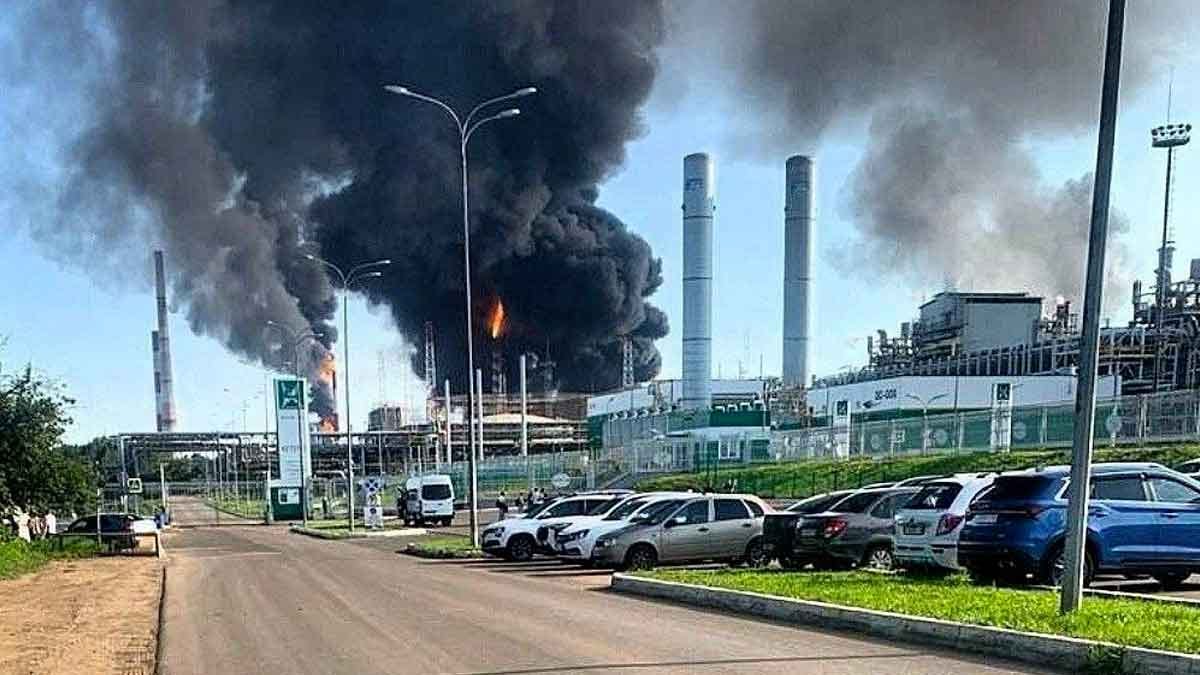
The Big Story: Ukrainian drones hit three more Russian refineries, as the fuel crisis gets worse
On Tuesday, Russia’s Deputy Prime Minister Alexander Novak instructed federal government agencies, regional authorities, and refiners to continue monitoring the fuel market on a daily basis. He said that all possible measures must be taken to prevent localized supply disruptions. He described the fuel supply situation as “tense,” after weeks of denying there were any problems.
If Novak thought he had problems on Tuesday, it got significantly worse overnight.
In Russia’s Saratov region, the Rosneft Saratovsky Oil Refinery was successfully attacked, forcing a shutdown and causing major fires. Attacked at least ten times since 2025, when fully operational the refinery could process 7.3 million tonnes (metric) of crude oil.
In the Republic of Tatarstan, multiple drones struck the PJSC Tatneft TANECO and Sibur-RT AIF-NK Oil Refineries in Nizhnekamsk. There was no air defense or mobile fire teams at the compound, as workers watched FP-1 long-range drones freely striking both refineries. The air raid lasted for over an hour.
The TANECO refinery can process 16 million tonnes of crude, and the AIF-NK refinery can process 8.3 million tonnes. The compound is also one of Russia’s largest producers of synthetic rubber used by the military.
In the Republic of Bashkortostan, drones hit the Cherkasy Linear Product and Dispatch Station for the Transneft Ural Pipeline in Ufa. The pumping station connects pipelines that move crude oil west and supply the Russian refineries in Ufa.
After yesterday’s attack, the Omsk Oil Refinery has been shut down, with third-party confirmation that the AVT-10 and AVT-11 units were damaged. The refinery stopped sales on the St. Petersburg Mercantile Exchange. The AVT-10 unit could process 8 million tonnes of crude, and is so severely damaged that it may be offline until 2027.
Across Russia, despite a directive from the Kremlin not to report on refinery strikes and the fuel crisis, the fuel situation continues to get worse.
If people can’t get fuel, they can’t get to work.
If they can’t get to work, they don’t get paid.
When workers are stuck at home, factories can’t produce.
When factories can produce goods, store shelves become empty.
When scarcity hits, and people aren’t paid, and they no longer have mobility, fear sets in.
Societal fear is typically expressed as anger, directed at the government.
Today, Russia is only at the first stage. If the country reaches the second stage, each rung of the ladder is climbed faster.
This worst-case scenario is still months away, but time is running out. If Russia doesn’t solve the energy crisis by the end of August, the possibility of this becoming reality in some regions, especially in the East, starts creeping closer.
Russia’s vastness was one of its greatest military assets. Ukraine’s long-range attacks have turned it into a weapon. The Kremlin invested hundreds of millions of dollars in information warfare to peel away US support from Ukraine. That support came with a price. Washington could dictate what, when, and how Ukraine could attack Russia within its 1991 borders. Moscow may have gotten the Trump administration to stop providing direct aid, at the cost of Ukraine no longer needing to ask permission to attack Russia.
With fuel costs skyrocketing and the supply getting tighter, Russia is also facing a new surge in inflation. Everything you use and buy is tied to the price and availability of diesel fuel. Free-range, cruelty-free, locally sourced organic tomatoes don’t walk themselves to the market. They’re brought there in a truck. There is already evidence that Russia’s transnational trucking logistics are cracking due to fuel restrictions.
Russia’s railroad logistics are useless if products and raw resources are trapped at depots, warehouses, and distribution centers. Logistics is about the last mile, and Russia’s vastness makes that a weakness.
There is a misconception in the West that the Russian people have a limitless ability to suffer through hardship. History shows that’s untrue. Russia has had massive upheaval due to the people hitting their limits, including four times in the last 125 years.
The moment enough people are unsure they’ll have a warm bed and three meals in the next 24 hours, society, even in authoritarian regimes, starts to fall apart. In the Far East, Russians will have a bed to sleep in, but if the fuel crisis isn’t resolved, some may not have heat and electricity.
If scarcity triggers hyperinflation and accelerates the ongoing slow-motion bank run? That’s an event that could push Russia right off a cliff, as most Russian banks already have a liquidity crisis.
Russia has about 60 days to restore its refinery capacity, or replace the fuel through other nations, or prepare for mass protests in the late fall. That’s the path Russia is on.
For now, Moscow is choosing option four. There is no problem. There’s plenty of fuel. Refinery capacity can meet demand. It’s just panic buying. All drones and missiles intercepted. It was just debris. The harvest proceeds normally. Don’t spread fake news. Don’t talk about the problem. If we pretend a fuel crisis doesn’t exist, maybe it will go away.
The Kremlin may be clinging to its official policy of denial, but you know it’s a serious problem when State Duma deputies start saying publicly, stop lying about the fuel and harvest situation.
It comes down to simple math.
Russia has X refineries, and that number is getting smaller every day.
Ukraine has Y long-range drones, and that number is getting larger.
Ukraine has a lot more drones than Russia has refineries. With air defense, radar, and command and control already severely degraded, Russia demonstrated today it is incapable of defending its remaining operational refineries.
If you’re expecting Russia to experience a collapse like 1917, you’re going to be very disappointed. That won’t happen for many reasons. Russia won’t “collapse.” What’s more likely to happen is Russia will repeat its glorious 175-year history of bankrupting itself during war and being forced to the negotiation table.
Daily Assessment
We assess the following:
1. In our assessment, Russia’s occupation government in Crimea is incapable of managing the multisystem failures in logistics, energy, finance, and communications caused by Ukraine’s attacks.
2. Russia has reached an inflection point signaling the start of a broad national decline due to combined issues of force generation, the fuel and logistics crisis caused by Ukraine’s deep-strike capabilities, domestic arms production limitations, federal and regional budget deficits, financial stress causing socio-economic decline, systemic government fear of its own population, and shrinking global soft power. In our assessment, if left unaddressed, these issues could lead to civil unrest in the most impacted regions.
3. There is a moderate chance that Russia will conduct nationwide mobilization in the second half of 2026, with some Russian regions already beginning forced mobilization because they are not meeting their recruiting goals.
4. The increase in Russian picture reports and false capture claims, which coincide with renewed dialogue between Washington and Moscow, is a major information warfare operation. It is intended to claim renewed battlefield progress falsely and specifically targets the Trump administration.
5. In our assessment, Russia will continue to increase its attacks against civilians and civilian infrastructure in an attempt to break the morale of Ukraine’s civilian population.
Today’s downloadable Russia-Ukraine War SITREP No. 1,058, for July 7, 2026, is 83 pages long and a full report.
It has been 4,521 days since Russia started the Russia-Ukraine War by invading Crimea, 483 days since Ukraine accepted an unconditional ceasefire, and day 12 of President Zelenskyy’s 40-day campaign to force Russia back to peace talks.
You can visit our interactive Russia-Ukraine War Map for the latest tactical situation in the theatre of war.
Theaterwide
On the opening day of the NATO Summit in Ankara, Ukraine’s President Volodymyr Zelenskyy said, “War has changed fundamentally,” highlighting the innovation in drone warfare. He also called for more PAC-3 interceptors for the Patriot air defense system, and pushed to reinvigorate Ukraine’s membership in NATO.
Ukraine’s Foreign Minister Andrii Sybiha said that Kyiv no longer has to ask permission from any of its allies for long-range attacks, adding that the strikes will continue. He also announced that he received an invitation from China’s Foreign Minister Wang Yi to meet in Beijing.
In June, Ukraine launched Phase II of Operation Auchan. Over 2 days, drones specifically designed to destroy artillery barrels targeted 231 Russian artillery systems, with 171 confirmed hits.
The Ukrainian woman suspected of carrying out the attempted assassination of Ukrainian oligarch Vadim Ermolaev in Monaco, Anastasia Berezovskaya, was found in the woods near Kyiv. A former law enforcement officer and a current officer of the Main Intelligence Directorate of Ukraine (HUR) were arrested.
Do you want to view today’s full report with our analysis, maps, links to videos and pictures, and the rest of our in-depth coverage? Upgrade your subscription to read our premium content. If you’re already a paid subscriber, the download button for today’s report is at the end of the summary report.
Ukraine’s State Bureau of Investigation (SBI) conducted searches at the offices of drone manufacturer Vyriy Industries and the home of the company’s CEO, Oleksiy Babenko. SBI is investigating up to $4.4 million in alleged contract irregularities and overcharges for drones.
